In 2013, Y Combinator proposed a new instrument: the Simple Agreement for Future Equity (‘SAFE’). Refined in Silicon Valley over recent years, the model aimed to establish standardised documents offering broad benefits to the start-up community at the lowest practicable cost to investors and companies.
Easier and faster
A SAFE allows funding to be provided before the terms of a future equity round are agreed. Settlement depends on the event and the version of the agreement: a funding round may trigger conversion, whereas a sale or liquidation may lead to settlement on different terms. Not every event results in shares being acquired.
An alternative to convertible bonds
The SAFE structure is proposed as an alternative to other debt instruments (convertible bonds), which require the parties to agree detailed provisions on matters such as interest, maturity, the risk of insolvency and subordination of claims. Under Polish law, entities issue convertible bonds pursuant to Article 19 of the Bonds Act of 15 January 2015.
These instruments combine elements of bonds and options, and, on the terms agreed by the parties, the bondholder may demand that the bonds issued by the company be converted into shares. As investors often need to inject capital into a company quickly so that it can begin operating without delay, issuing convertible bonds may unnecessarily prolong negotiations over the detailed investment terms.
How does it work?
With the basic form of SAFE, the parties need agree only a valuation cap or a discount rate. The essence of a SAFE is that the price of the shares received on conversion by investors holding SAFEs is lower than the price of the securities issued to VC investors in the next funding round. That price is based on either the valuation cap or the discount rate.
A standard SAFE is not a conventional interest-bearing loan with a maturity date. This does not mean, however, that it is risk-free or that future conversion is the investor's only right. The provisions on financing, liquidity events, dissolution of the company and payment priority must be read carefully.
The list of variants described in the original publication is historical. Y Combinator introduced the post-money SAFE model in 2018 and provides current forms and guidance on its website. Before analysing dilution, check the document version and the definitions of capitalisation. A foreign template requires a separate assessment before it is used for a Polish company.
Following Y Combinator, which first released a complete set of draft SAFE documents, other participants in the startup community proposed instruments similar to the one described above: law firm Wilson Sonsini Goodrich & Rosati proposed a 'convertible security', and accelerator 500 Startups introduced an instrument called 'The Keep it Simple Security (KISS)'.
A solution that is not for everyone?
When introducing SAFE, Y Combinator stated that it intended the solution to be fair to both investors and companies. However, reports online suggest that many founders whose companies entered into SAFEs with investors did not fare well. This has been attributed to a failure to perform basic calculations of the dilution of their own holdings following conversion of the instruments issued. In addition, many founders tended to associate the valuation cap with the future level of the funding round and assumed that any discounts entailed only a minimal premium in the next funding round.
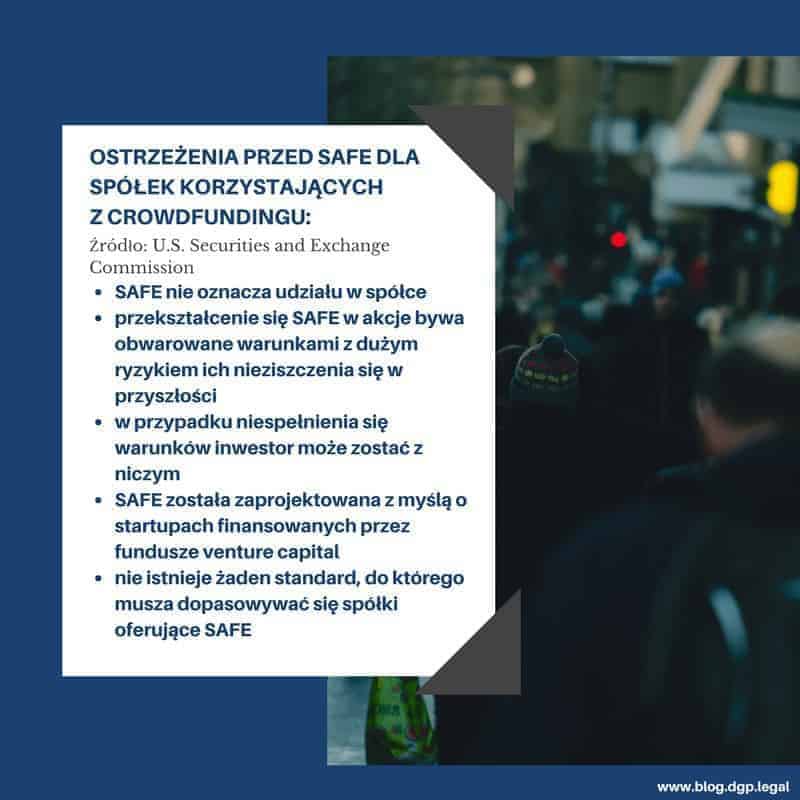
It therefore appears that the adverse effects of using SAFEs arose from founders' insufficient business awareness and a level of economic and legal knowledge inadequate for this instrument. It is also worth mentioning that, in May 2017, the U.S. Securities and Exchange Commission warned about SAFEs used by companies in crowdfunding, under which SEC rules permitted more than USD 1 million to be raised online from retail investors.
The main threat identified for small investors was the risk that no event triggering conversion of the SAFE into company shares would occur (for example, excellent company performance eliminating the need to increase its capital). Other pitfalls facing non-professional investors were also highlighted (more: https://www.sec.gov/oiea/investor-alerts-and-bulletins/ib_safes).
Although the use of this solution by businesses in crowdfunding should be viewed unfavourably, it should be remembered that SAFE was designed for professional VC investors to enable rapid investment in high-potential startups. In that context, it should be regarded as a transaction model that fulfils its intended purposes to the expected extent.