
Startup founders now understand very well that money does not always change the pace of work. Funding serves a specific purpose: scaling expenditure on marketing, sales and R&D…
MO: Can you identify one pivotal event, project or collaboration with another fund that changed how you see the industry?
BJ: I was not involved in those events, but even as an observer I found the story of Base very inspiring. I had already been following Applicake — its culture was fundamentally different from what I knew and what was happening in the market at the time. It was a group of young people who shared knowledge at the highest level and organised conferences with attention to every detail. This was a software company that cared about the little things: just dig out old photographs of the Applicake office online. That may sound trivial, but they also did excellent programming work, and the atmosphere attracted talented people. A merger followed, and the company became part of the bigger idea that was Base. There is wisdom in recognising that you cannot keep working alone for ever: you have to find a partner. That approach resulted in USD 53 million in investment. I have another personal story about a naïve view of the startup world. I once posted an article online criticising Estimote, which people in the industry were quick to like. I was surprised that such a large investment had produced no spectacular results. That was very childish thinking: once the money arrives, success is just around the corner. I did not understand that a market has its own pace. Companies are not built overnight. There are exceptions, of course, but that is not how it generally works. Today, when I run training, I say that no genius in the world could have designed Facebook as it is from the outset. The product Mark Zuckerberg devised years ago was relatively primitive, quite different from what we have today. Adapting, developing and evolving the product: that is what makes a wise CEO, rather than being able to do something here and now, instantly. With Estimote, I thought that after raising around USD 3 million, going through Y Combinator and receiving all that media attention, the company would be everywhere within a year. Startup founders now understand very well that money does not always change the pace of work. Funding serves a specific purpose: scaling expenditure on marketing, sales and R&D. But you cannot do it on the assumption that you are simply adding fuel to make the fire bigger.
I think nobody in Poland is now simply looking for people with ideas. Reaktor is one of the few places where you can turn up with just a concept, but let us be clear: it is a kind of school. They help you find your focus and understand what you want to do. Investment and actual funding come later, once someone demonstrates that they can sell their product.
MG: Through the KPT ScaleUp accelerator, you supported startups with PLN 200,000. How should that money be used?
BJ: That money is very useful when an early-stage company already has a product. Ideally, I would like to see projects spending the PLN 200,000 on market tests to verify their hypotheses. For example, 'we have already sold two subscriptions in Brazil, so intensifying promotion there might produce much better conversion than anywhere else”.
MG: Somewhere between an MVP and a fully developed product, where much more money is needed?
BJ: I do not see that PLN 200,000 as project funding at all. In fact, our assessment takes this into account: if we see that the project's very survival depends on that money, we tend not to support it. Several companies from the first cohort already have investors, one obtained funds from the National Centre for Research and Development, and some are not yet looking for money because the founders have realised it is too early and they can still optimise the business. In that sense, an acceleration programme is not there to finance a project, certainly not a prototype. I think nobody in Poland is now simply looking for people with ideas. Reaktor is one of the few places where you can turn up with just a concept, but let us be clear: it is a kind of exclusive school. They help you focus and understand what you want to do. Investment and actual funding come later, once someone demonstrates that they can sell their product.
That group of early adopters must be influential. The business must be able to move beyond novelty and gadgets to a product that customers value enough to want to own.
MO: After the programme's first edition, did you feel that startups knew where to invest their money?
BJ: We encourage founders not to focus on just one type of activity. They are tempted to put everything into product development or marketing. During an acceleration programme, it is worth exploring your hypotheses as broadly as possible, attending different events and looking around. Later, you need to focus and pursue a coherent strategy, at least for a while. Then the crucial thing is to design the test properly, so that you cannot rationalise the outcome afterwards. A good test will tell us 'yes' or 'no'. We once had a startup whose hypothesis was that experienced salespeople in the target market, given the product, would sell it very effectively and become the main distribution channel. The test was so carefully designed that after a few months we could say, 'OK, this does not work'. There were no excuses about preparing better materials or changing the partner: we knew exactly what had gone wrong. This is a very reassuring approach from an investor's perspective, too.
MO: Do you see the lack of ideas for a good test as startups' biggest mistake?
BJ: We call it simply 'burning through money': they burn through EU funds and investors' money alike. Then there are cognitive problems, such as seeking confirmation of our own assumptions and being convinced we are right. It is very difficult: to get started at all, you need confidence, determination and the conviction that you have something exceptional to offer. Then it turns out that you must also become a master at questioning your own confidence.
MG: So the gold goes to the bold, but also the humble?
BJ: I wonder whether that implies a kind of bipolarity, almost pathological: on the one hand, you must be utterly convinced you are right, and on the other, willing to test every assumption in your head…
Poland is an interesting country for commerce and fintech because, despite our habitual complaints and the way we have grown used to seeing ourselves, our banking and online banking services are actually very advanced.
MG: Based on your observations, could you suggest promising directions for people who would like to begin their business journey?
BJ: First, people usually begin entrepreneurship with some experience behind them: university, a first job. I certainly do not encourage radical life changes along the lines of 'he has graduated in medicine but is going to create a startup in a completely different field'. Second, access to the market. It is sad to see consumer startups with no potential customer within 500 km and nobody nearby with experience in that particular industry. Poland's very strong furniture industry illustrates the point well. If you start a business in that field, you may need an experienced sales representative who has sold furniture worldwide. We will probably find one relatively easily, and can already begin building a capable team. Suppliers, knowledge of trends, distribution channels and know-how are within reach. Food production is another interesting sector: still not very innovative, but a very strong exporter. Are there lots of manufacturing and industrial companies around you? Develop solutions for industry — Industry 4.0. We also have many companies in BPO ('business process outsourcing'), where there is now scope to seek optimisation. Global groups such as SAP dominate the market, but you can always try to offer them solutions or projects to acquire. In this field, it is very easy in Kraków to find a research sample and test whether an idea works. An average startup needs to hold a dozen to several dozen conversations with prospective customers to understand clearly whether it is on the right track. In BPO, this is relatively simple because there are so many companies. Poland is an interesting country for commerce and fintech because, despite our habitual complaints and the way we see ourselves, our banking services are actually very advanced. In Germany, even paying by card is by no means a given, let alone PayPass. The United States went wild with excitement over paying with an iPhone wallet. For us, that is a nice novelty, not a revolution: we use contactless stickers on phones and Google Pay, and individual banks' apps also support contactless payments. That makes fintech solutions relatively easy to spread in Poland. Look for areas where the market is large and we are somewhat ahead. There is much talk of VR and blockchain, markets that are still largely untouched. Nobody has pulled away yet. The question is whether we can actually create a competitive advantage. Many aspiring startup founders think less about competitive advantage than about first-mover advantage, the advantage of being first to market, and hope it will solve everything. It is sometimes important, of course, but not decisive, and certainly not something to rely on. When you say you are first, that is usually untrue: a team in the United States, China or the United Kingdom is already working on something very similar, even if nobody has heard of it yet. They may also start a week later and overtake you, so you begin first and finish last. The key challenge is to find your place in the market quickly, position yourself, occupy a niche and create a competitive advantage. Of course, someone will always produce more cheaply, so you do not need to be the cheapest, best and fastest all at once. It is better to focus on one of those qualities.
I have been working on Industry 4.0 for some time, and it currently looks very promising. Polish industrial companies can afford new technologies, and the industry needs smart innovations that are easy to implement and improve productivity and efficiency.
MG: Here in Kraków we have ample opportunities to test cooperation with corporations. How does this work at Kraków Technology Park? Do you work with organisations such as ABB, which have recently become much more engaged with the city?
BJ: Such partnerships certainly have great potential, but they also require considerable resources and are demanding for both sides. We already have experience working with large companies, including through the KPT ScaleUp accelerator. We have not worked with ABB specifically, but I think it is only a matter of time… [laughs]. We have an offering for corporations: we help them find external innovation and establish internal innovation teams and procedures. Yes, innovation and procedure in the same sentence. Beyond opening up, corporations have a great deal of work to do. We want to help and hope they are genuinely ready. Another corporate phenomenon we are watching for is spin-offs: people leaving with their own business ideas and returning with a new product addressing problems they encountered while working there.
MG: We ask about cooperation with large companies because you occupy a unique position: KPT is both a technology park supporting smaller businesses and the manager of an economic zone hosting corporations such as Motorola. It seems a natural candidate to connect those worlds.
BJ: Yes, we have a unique position and operate in both of those different worlds. But you should certainly not think of us as a hub where everything will connect. That belongs to the previous decade. We are an active and, I hope, valuable participant in the ecosystem. We encourage companies to experiment and find their own paths and partners. And we are building what I consider quite an attractive offering in this open market. Perhaps one little anecdote illustrates those two worlds. Recently, I attended two conferences on consecutive days. At one, people talked about pivots; at the other, about switching railway points. I think the speakers had very similar intentions. And we were present at both conferences.
MO: On a more personal note, rather than speaking for KPT: if you had your own fund with no financial or geographical constraints, which industry would you invest in? Which five projects would you want in your portfolio?
BJ: I do not think particular industries are better than others. It is more about feeling that I can help a specific project. I have been an investor for a relatively short time, am still learning to support startups and exploring, and remain fascinated by it. I have been working on Industry 4.0 for some time, and it currently looks very promising. Polish industrial companies can afford new technologies, and the industry needs smart innovations that are easy to implement and improve productivity and efficiency. In that sense, Industry 4.0 is less 'romantic' than stories of sending rockets to Mars. In the long run, I think the only sensible strategy is to focus on a specific area and act with considerable consistency.
MG and MO: Thank you for the conversation.
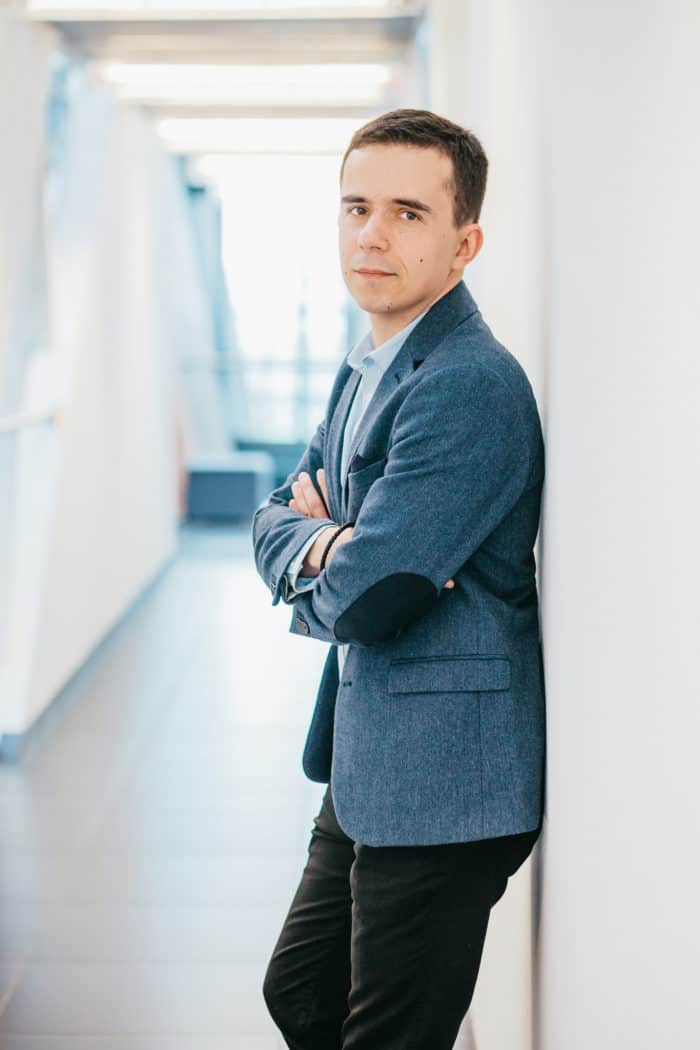
Bartosz Józefowski
Management board member of the KPT Seed Fund. From 2013 to 2017, he was responsible for the technology incubator and all startup activities at Kraków Technology Park. He now leads the KPT ScaleUp acceleration programme. He is deeply involved in Kraków's startup community and nationally as a Startup Poland ambassador. Fascinated by behavioural economics and new technologies, and a Beatles fan.