
An exit strategy is the logical complement to any investment idea. It should limit downside risk and secure potential upside. A venture fund investing in private assets must manage those risks effectively. Liquidation preference clauses are one of its principal legal tools.
What are liquidation preferences and how do they work?
Liquidation preferences (liquidation preference) set the order and proportions for distributing funds on events specified in the agreement, such as a company sale. They may give investors priority over other shareholders. They do not, however, guarantee recovery of the investment: payment depends on available funds, creditors’ rights, the transaction structure and the effectiveness of the arrangements.
There is no universally accepted definition of liquidation events. Economically, they are events that may theoretically create actual or hypothetical liquidity for the company or its shareholders, allowing shares to be exchanged for cash. They commonly include voluntary or insolvency-driven liquidation, mergers or divisions, sales, share redemptions, capital increases resulting in a change of control, and disposal of the entire business or a substantial part of its assets.
Liquidation preferences therefore protect the fund’s investment both in a crisis and on potentially positive events, such as a successful sale to a strategic buyer or private equity fund.
Participation in proceeds and dangerous multiples
A liquidation preference should be distinguished from participation rights in proceeds arising from a liquidation event.
If a fund has secured only priority repayment of its total investment, potentially plus declared but unpaid dividends, it will not participate with ordinary shareholders in distributing the remaining proceeds, for example from the sale of a controlling stake. This is a non-participating preference, economically similar to a debt instrument. Typically, however, the investor may choose between exercising its preferred return of capital and any agreed premium, or waiving the preference entirely and sharing the sale proceeds pro rata with other ordinary shareholders.
Funds often seek a ‘double dip’: priority repayment of capital plus a premium, or a multiple of capital, followed by pro rata participation in the remaining proceeds. This is a participating preference, which may be capped.
A liquidation preference returning the investment plus unpaid dividends is generally regarded as a reasonable and fair minimum. Sometimes, particularly at an early investment stage, funds demand more, including multiples of invested capital or a specified rate of return.
Each case is different, and such expectations can sometimes be commercially justified, but we advise considerable caution. Accepting multiples too readily can prove very costly later, not only for founders or principal shareholders but also for managers and key employees recruited with promises of share options.
What makes sense for investors and companies?
Professional funds generally avoid excessive preference at the expense of other shareholders and option holders. Overly demanding preferences undermine motivation. In early funding rounds, a fund may also rightly expect later investors to demand identical or stronger rights and seniority in exercising liquidation entitlements and guarantees. It is easy to fall victim to one’s own terms, making reasonable compromise and balanced interests essential.
How does this work in practice?
Consider three examples; some legal issues have been simplified for clarity:
Example 1 – A fund invests PLN 2 million for 25% of the company’s share capital, a PLN 8 million post-money valuation. It receives preferred shares with a non-participating liquidation preference returning invested capital. The company misses business-plan milestones and the market changes sharply as numerous strong competitors enter. It is dissolved, and asset sales yield PLN 3 million after liabilities and liquidation costs are paid.
The preference returns the fund’s full PLN 2 million investment. Other shareholders, despite holding 75% of the company, divide the remaining PLN 1 million proportionately. Option holders receive nothing.
Example 2 – A fund invests PLN 5 million for 20% of share capital, a PLN 25 million post-money valuation. Its preferred shares carry a participating liquidation preference returning three times the investment. The company grows well and soon receives a PLN 40 million acquisition offer.
On acquisition, the fund receives three times its capital, PLN 15 million, and participates alongside the other shareholders in distributing the remaining PLN 25 million. Its total is therefore PLN 20 million, half the transaction proceeds. Holders of the remaining 80% of shares, together with managers and employees holding options, share the balance.
Example 3 – A fund invests PLN 5 million for 20% of share capital, a PLN 25 million post-money valuation. Its preferred shares carry a participating liquidation preference returning three times the investment, capped at five times the investment.
Alternatively, the fund may share proceeds on the same terms as other shareholders if it waives its liquidation preferences. The company performs exceptionally well and receives a PLN 200 million acquisition offer.
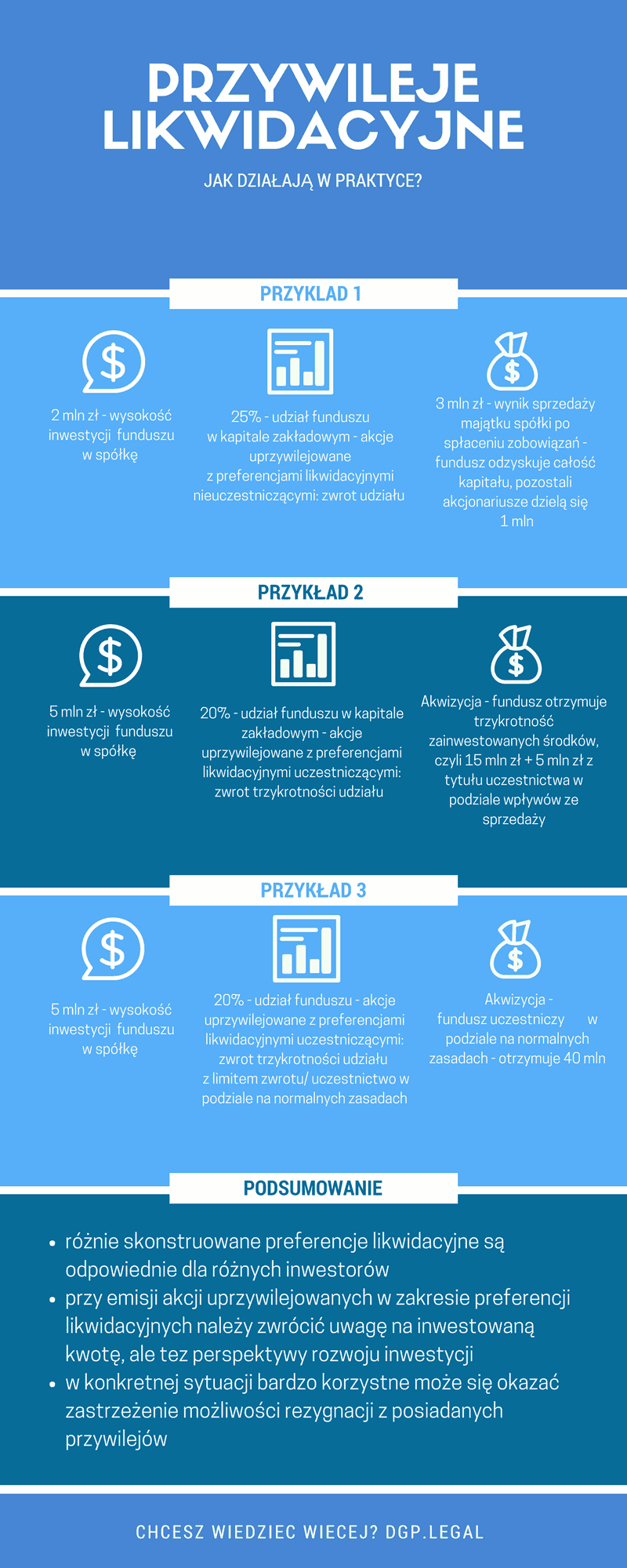
The rational choice is to waive the preferences and share pro rata. The fund then receives 20%, PLN 40 million, compared with PLN 25 million under the preference. The other shareholders and option holders participate according to their holdings and rights.
In Example 3, the fund’s payout before applying the cap is PLN 15 million + 20% × (transaction value − PLN 15 million). It reaches the PLN 25 million cap at a transaction value of PLN 65 million. Waiving the preference becomes more advantageous only above PLN 125 million, because 20% × PLN 125 million = PLN 25 million. The range over which the payout remains fixed at PLN 25 million is therefore PLN 65–125 million, not PLN 25–125 million. The calculation assumes the example’s terms, without additional fees, debt or other preference classes.
For completeness, where a company has raised capital from several investors over multiple rounds, matters can become considerably more complex because successive investors may hold different preferences and different payment seniority.
In future posts, we will consider whether all the objectives of liquidation preferences can be fully achieved under Polish company law. We will also examine technical aspects of these clauses in particular situations, such as company mergers and divisions.