
VC funds investing in growing companies primarily seek the return envisaged when the agreement is signed, after a specified investment period, usually up to ten years. The following exit routes are currently identified: (1) sale of shares or the business (M&A) to an industry or financial investor; (2) a buyout of shares or the business; (3) an IPO, in which the shares held by the VC fund are sold and (4) liquidation of the company. Let us examine the penultimate route: an IPO exit.
Although the choice of route depends on the success of the investee company, the preferred exit is defined when the investment agreement is concluded. It reflects the industry's structure, the company's position and general capital-market conditions. Additional requirements imposed on companies in these transactions must also be considered, including those planning an offer on the Warsaw Stock Exchange's Main Market, such as capitalisation levels and operating history..
Exits in 2016: predominantly sales to another private equity firm
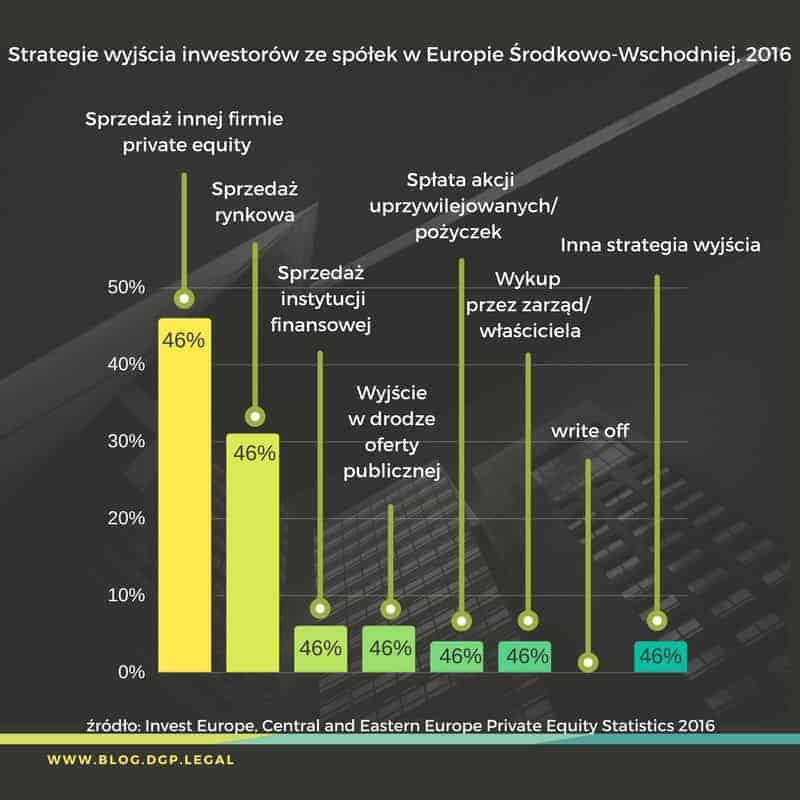
According to Invest Europe's Central and Eastern Europe Private Equity Statistics 2016 report (available on its website https://www.investeurope.eu/media/671537/invest-europe_cee_privateequitystatistics2016_24082017.pdf ), Poland was again the region's largest exit market in 2016: EUR 363 million in divestments, 25% of the Central and Eastern European total. Exits involved 29 companies, representing 26% of the total number. Poland was also one of the three countries hosting the largest transactions, alongside Lithuania and the Czech Republic.
The most 'profitable' exit route in Central and Eastern Europe in 2016 was a secondary sale to another private equity firm: EUR 476 million, 46% of total divestment value, across 15 exits. The three largest such transactions accounted for 38% of the region's total divestment value in 2016. The second most popular route was selling shares or the business: EUR 214 million across 37 exits. The statistics show that VC exits through IPOs in Central and Eastern Europe involved just eight companies, with a total value of EUR 58 million.
Public offerings are falling out of favour
Dissatisfaction has also recently grown among entrepreneurs who chose a public offering. While the stock market provides investor capital and public-company transparency has advantages, both offering costs and the costs of remaining listed are substantial.
Additional regulations and procedures, backed by penalties for non-compliance, discourage companies from remaining listed. The result is the growing number of delistings observed for some time. In future, IPO exits can therefore be expected to remain unpopular not only because of capital-market conditions but also because companies are reluctant to become public.
These statistics show that, although investment agreements commonly provide for an exit by taking the company public through an IPO, this is not currently popular. Unlike the Western market, particularly the United States, most European exits take place in the private market through M&A transactions.
Further articles will continue the theme of investment exits, including how to draft contractual clauses governing an investor's departure from a company.