
The tax exemption for share exchanges, set out in Polish law in Article 24(8a) of the Personal Income Tax Act and Article 12(4d) of the Corporate Income Tax Act respectively, perfectly illustrates how the structure of capital transactions is closely determined by the interpretation of tax legislation. It also reveals a radical and entirely unnecessary divergence, or in practical terms even a split, between the legal order recognised by the tax authorities and that resulting from consistent, uniform administrative court judgments.
What is a share exchange?
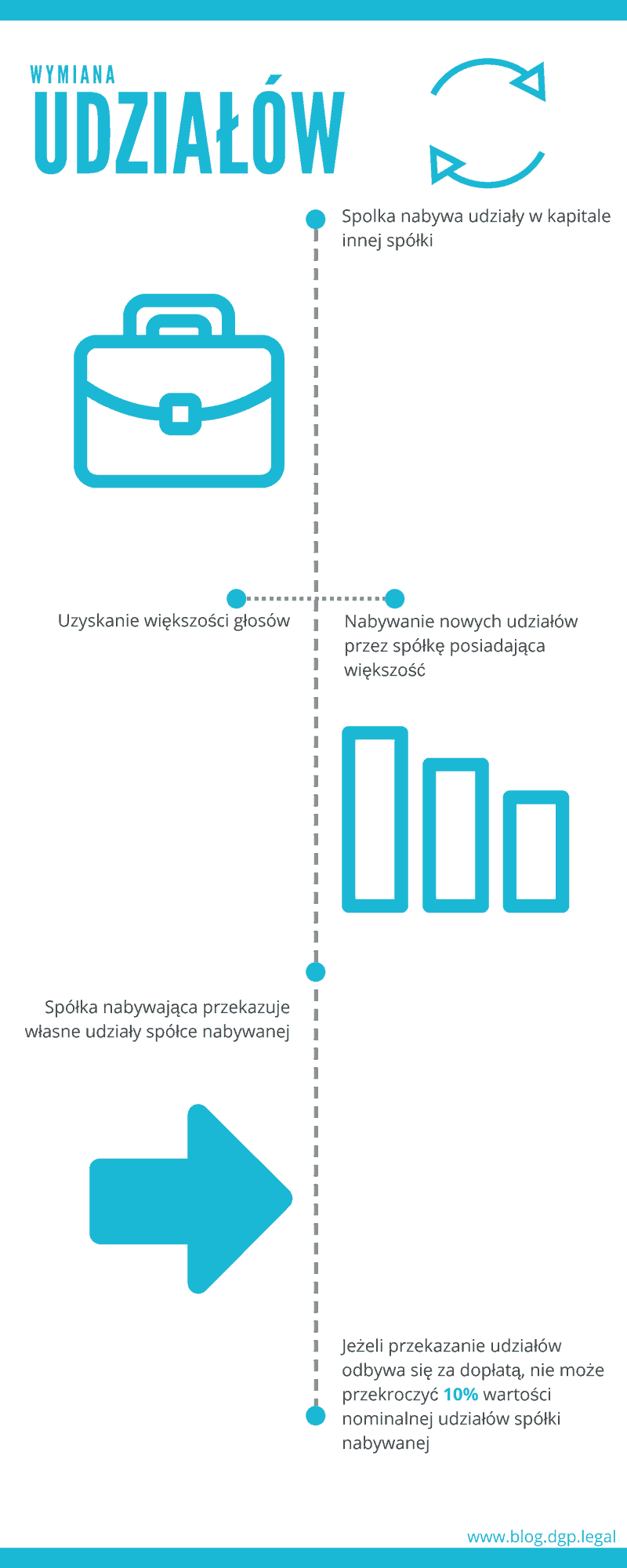
A share exchange is defined as the acquisition by one company, the acquiring company, of shares in another, the acquired company, resulting in a majority of voting rights in the acquired company or, where that majority is already held, the acquisition of further shares.
In return, the acquiring company gives its own shares to the acquired company's shareholders, potentially together with a cash payment not exceeding 10% of the nominal value of those shares or, if there is no nominal value, the market value of the acquiring company's shares transferred to the acquired company's shareholders.
The definition of a share exchange and the associated tax exemption implement Article 2(e) and Article 8(1) of Council Directive 2009/133/EC of 19 October 2009 on the common system of taxation applicable to mergers, divisions, partial divisions, transfers of assets and exchanges of shares (…). The exemption plays a very important role in capital consolidation where, for various reasons, a direct merger is impossible or undesirable.
Typical transactions aim, among other things, to bring several independent businesses previously owned by one person or a group acting together into a corporate group, to reorganise corporate groups, or to make acquisitions through a share exchange (swap acquisition).
Controversies in statutory interpretation
Leaving aside the initial period of Poland's share-exchange rules, when the mechanism was introduced only into the Corporate Income Tax Act without equivalent PIT rules (a position inconsistent with European interpretation of the relevant tax directives that persisted from Poland's EU accession in 2004 until 2011; see http://curia.europa.eu/juris/liste.jsf?language=en&num=C-321/05, http://curia.europa.eu/juris/liste.jsf?language=en&jur=C,T,F&num=C-%2028/95&td=ALL), interpretation problems centred on two issues:
1) the persons covered by the exemption: whether the shares conferring a majority of votes must be transferred by one shareholder or may be transferred by a group; and
2) timing: whether the share exchange must take place in a single transaction or whether several transactions may be spread over time.
Attempts to dispel the doubts
The latest amendment to the PIT and CIT share-exchange rules, effective from 1 January 2015, was intended to resolve these issues and end the disputes definitively. Following amendments to Article 24(8a) and (8b) of the PIT Act and Article 12(4d) and (11) of the CIT Act, and especially the introduction of Article 24(8c) PIT and Article 12(12) CIT, it appeared that the exemption's availability for exchanges by groups of shareholders would no longer be in doubt. The same applied to exchanges involving several transactions, provided, as the legislature required, that they took place within six months of the month of the first acquisition.
An adverse interpretation by the Minister of Finance
Unfortunately, the Minister of Finance decided to amend, on its own initiative, the taxpayer-favourable individual ruling of 2 December 2015, IPPB2/4511-960/15-4/PW. In the amending ruling of 22 February 2016, DD9.8220.2.46.2016.KZU, the Minister declared the taxpayer's position incorrect.
Relying on the drafting change to Article 24(8a) PIT and Article 12(4d) CIT, where the 2015 amendment replaced the plural 'shareholders' with the singular 'shareholder', the Minister stated categorically: 'In defining the conditions under which a contribution in kind of shares in another company is recognised as a share exchange, the Act introduced the singular term “shareholder” in place of the previous plural “shareholders”. (…) A tax-neutral share exchange occurs where shares in another company are acquired from a single shareholder of that company (…).'
This interpretation is plainly wrong because, in a manner embarrassing for the Minister, it disregards the official explanatory memorandum to the government's bill amending PIT and CIT (parliamentary paper no. 2330 of 14 April 2014), which, regarding the identically worded proposed provisions, stated: 'In addition to drafting and consequential changes, a rule is introduced to clarify the persons covered by the exemption and indicate that fulfilment of the conditions for share-exchange transactions may be assessed by reference to a group of shareholders, provided that the exchanges resulting in fulfilment of the exemption conditions took place in the six months preceding the acquisition of an absolute majority of voting rights in the company whose shares are acquired.'
The courts' position
As expected, the administrative courts disagreed with the Minister. They held that restricting the rules to cases where each shareholder exchanges shares separately 'would impose an excessively restrictive condition, substantially frustrating the objectives of Council Directive 2009/133/EC', and that 'replacing “shareholders” with “shareholder” cannot be interpreted as restricting the neutrality of share exchanges guaranteed by Directive 2009/133/EC as implemented in Polish law.'
This view became widely accepted in case law: III SA/Wa 2698/16, Warsaw Regional Administrative Court, 17 August 2017; I SA/Wr 463/17, Wrocław Regional Administrative Court, 26 July 2017; I SA/Po 199/17, Poznań Regional Administrative Court, 28 June 2017; I SA/Gd 1573/16, Gdańsk Regional Administrative Court, 15 March 2017; I SA/Sz 862/16, Szczecin Regional Administrative Court, 3 November 2016; I SA/Wr 449/16, Wrocław Regional Administrative Court, 7 September 2016; I SA/Łd 453/16, Łódź Regional Administrative Court, 3 August 2016; I SA/Gl 409/16, Gliwice Regional Administrative Court, 22 June 2016; and VI SA/Wa 194/15, Warsaw Regional Administrative Court, 2 September 2015.
The tax administration's insistence on a position consistently rejected by the courts is striking. This is not, however, a feature of current policy but a chronic condition present under practically every successive administration. Citizens and taxpayers are left with the dispiriting impression of irrational action by the Republic's authorities, a lack of respect for citizens, erosion of the state's standing and, ultimately, wasted time for officials, judges and taxpayers themselves.
Paying taxes in connection with a company's activities can be very complicated. If you are planning a major transaction and considering its tax consequences, or simply need support in this area of your business, please contact us. We will discuss contentious issues and prepare the necessary legal and tax documentation.